Exatone
A science-driven, adaptive workout tracking app.
01What problem were we trying to solve?
Workout tracking felt fragmented, manual, and limited to notes or poorly designed apps.
Existing fitness apps lacked scientific accuracy in muscle tracking and failed to adapt to diverse goals (sports performance, fat loss, muscle gain, across genders).
There was no simple system that could log workouts effortlessly while still giving meaningful insights into muscle usage, recovery, and imbalance.
02What did we build, and what decisions mattered?
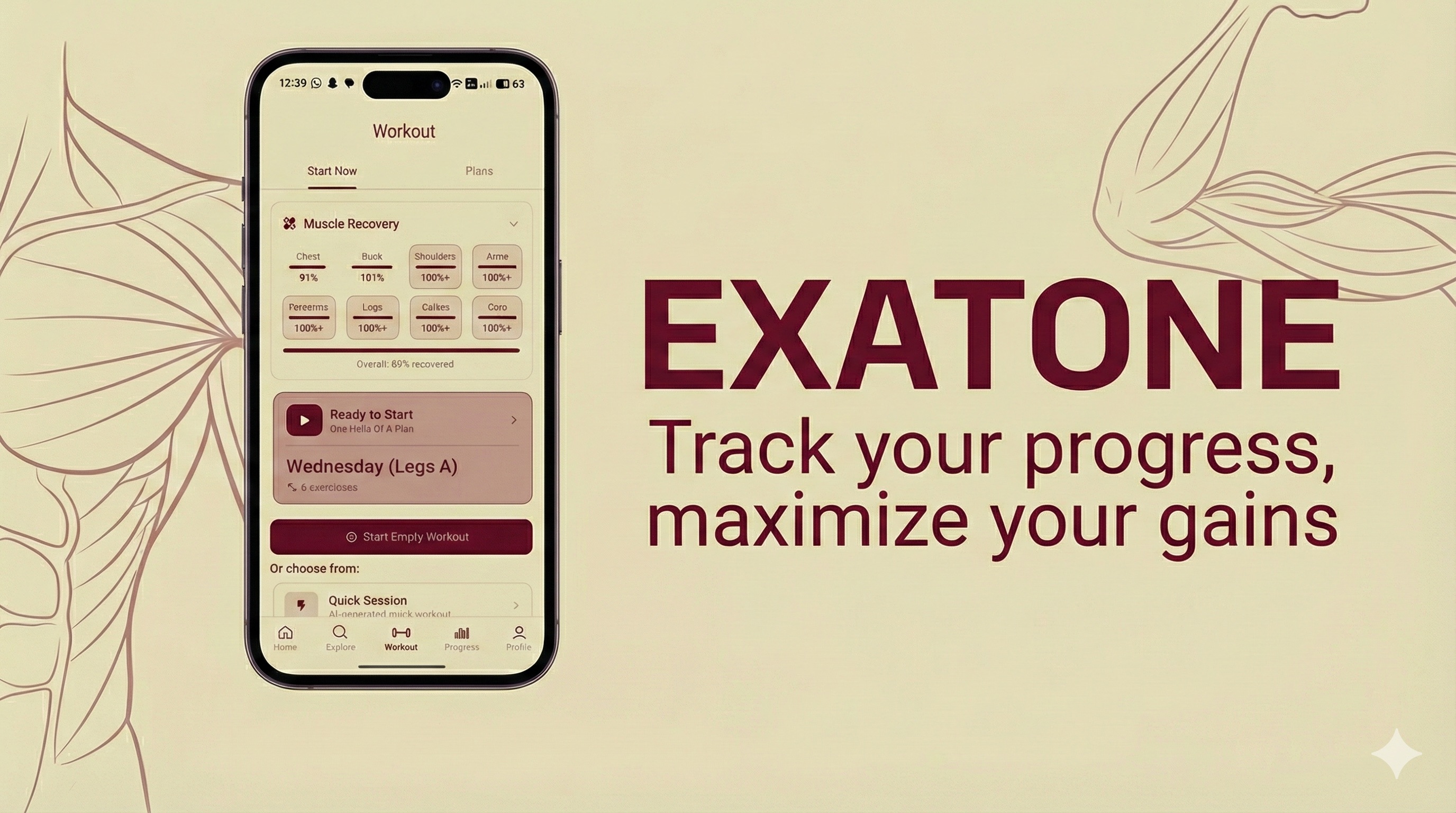
We built Exatone, a cross-platform workout tracking app that lets users log workouts in seconds while the system handles history, recovery, and muscle analysis.
The core decision was to keep the input extremely simple (exercise, reps, weight) and push all complexity into the backend logic and data modeling.
We chose Flutter for cross-platform consistency and Supabase for scalable, migration-friendly backend infrastructure, while consciously compromising on absolute biomechanical precision due to real-world gym machine variability.
03What changed or what did we learn because of it?
During beta testing, Exatone became a habit-forming tool, users instinctively logged workouts without friction, validating the UX direction.
A single UX change (slider-based input instead of keyboard entry) drastically improved usability, reinforcing that small interaction decisions can have outsized impact.
We learned that data quality is foundational, leading us to rework muscle-involvement datasets and postpone rushed AI features in favor of rebuilding them properly, including a future “Spot” feature, a real-time adaptive gym advisor.
Exatone taught us that great products are built by obsessing over data foundations, reducing user effort to the minimum, and letting insights emerge naturally from consistent use.